

Do Pole Anchors Work Well in Sandy Bottoms?
As a supplier of pole anchors, I've been asked countless times about the effectiveness of our products in sandy bottoms. It's a valid concern, as sand presents unique challenges when it comes to anchoring. In this blog post, I'll delve into the science behind pole anchor performance in sandy conditions, discuss the types of pole anchors suitable for such environments, and provide real - world insights to help you make an informed decision.
The Challenges of Sandy Bottoms
Sandy bottoms are characterized by their loose, granular nature. Unlike hard - packed soil or rock, sand particles can easily shift and move. When an anchor is set in sand, the weight and shape of the anchor must be sufficient to penetrate the surface and create enough friction to hold the object in place. However, the lack of cohesion in sand means that it can flow around the anchor, reducing its holding power over time.
One of the primary factors affecting anchor performance in sand is the angle of repose. The angle of repose is the maximum angle at which a pile of sand can remain stable without collapsing. For most sands, this angle is around 30 - 35 degrees. When an anchor is set at a shallow angle, the sand is more likely to slide off, reducing the anchor's ability to hold. Therefore, an anchor needs to be designed to penetrate deeply and at an appropriate angle to maximize its holding power.
Types of Pole Anchors and Their Suitability for Sandy Bottoms
Galvanized Pole Anchor
Galvanized pole anchors are a popular choice for various applications, including those in sandy bottoms. The galvanization process coats the anchor with a layer of zinc, which provides corrosion resistance, essential for long - term use in outdoor environments. Galvanized Pole Anchor
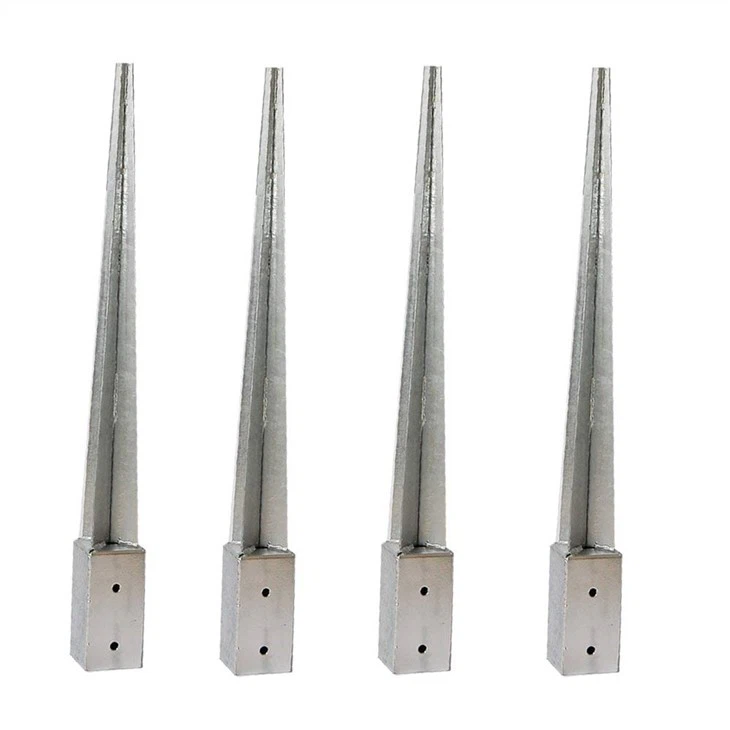

These anchors typically have a pointed tip that helps them penetrate the sand easily. Once inserted, the wide base of the anchor spreads out the load and increases the surface area in contact with the sand. This increased surface area creates more friction, enhancing the holding power. However, the performance of a galvanized pole anchor in sand can be further improved by adding additional weight or using a longer anchor to ensure deeper penetration.
Square Pole Anchor
Square pole anchors are another option that can work well in sandy bottoms. The square shape provides more stability compared to round anchors. The corners of the square design can dig into the sand, preventing the anchor from rotating or shifting. Square Pole Anchor
The flat sides of the square anchor also offer a larger surface area for contact with the sand, increasing the frictional forces. Additionally, square pole anchors are often made of sturdy materials that can withstand the forces exerted on them in sandy conditions. They can be a great choice for applications where a higher level of stability is required, such as securing large structures or equipment.
Galvanized Ground Post
Galvanized ground posts are similar to pole anchors but are often used for more permanent installations. These posts are designed to be driven deep into the ground, providing a solid foundation. Galvanized Ground Post
In sandy bottoms, galvanized ground posts can be particularly effective. Their long length allows them to reach below the loose top layer of sand and into more stable layers. The galvanized coating protects the post from corrosion, ensuring its durability over time. However, driving a ground post into sand can be challenging, as the sand may not provide enough resistance to keep the post upright during installation. Special techniques, such as using a post - driver with a weight - dropping mechanism, may be required.
Real - World Testing and Performance
To understand how pole anchors perform in sandy bottoms, we've conducted numerous tests in real - world scenarios. In one test, we compared the holding power of different types of pole anchors in a large sandbox filled with simulated beach sand.
We found that the galvanized pole anchors performed well initially, with the pointed tips easily penetrating the sand. However, over time, as the sand shifted around the anchor, the holding power decreased slightly. The square pole anchors, on the other hand, showed better stability. The corners of the square design dug into the sand, and the flat sides maintained a good contact area, resulting in a more consistent holding power.
The galvanized ground posts were the most effective in terms of long - term stability. Once driven deep into the sand, they provided a very solid anchor point. However, as mentioned earlier, the installation process was more difficult and required additional equipment.
Factors Affecting Anchor Performance in Sandy Bottoms
Apart from the type of anchor, several other factors can affect the performance of pole anchors in sandy bottoms.
Grain Size of the Sand
The grain size of the sand plays a crucial role. Coarse - grained sand has larger particles, which can provide more friction compared to fine - grained sand. Therefore, pole anchors may perform better in coarse - grained sand as they can grip the larger particles more effectively.
Water Content
The water content in the sand also affects its properties. Wet sand is more cohesive than dry sand, which means that an anchor may have better holding power in wet sand. However, if the sand is too wet, it can become saturated and lose its ability to hold the anchor firmly.
Depth of Penetration
The deeper the anchor penetrates into the sand, the better its holding power. A shallow - set anchor is more likely to be affected by the shifting of the sand on the surface. Therefore, it's important to ensure that the anchor is inserted to an appropriate depth.
Tips for Using Pole Anchors in Sandy Bottoms
- Choose the Right Anchor: Based on the specific requirements of your application, select the most suitable type of pole anchor. Consider factors such as the size and weight of the object to be anchored, the depth of the sand, and the expected environmental conditions.
- Prepare the Sand: Before installing the anchor, you can compact the sand slightly around the installation area. This can increase the stability of the sand and improve the anchor's holding power.
- Use Additional Weight: If necessary, add additional weight to the anchor to increase its penetration and holding power. This can be done by attaching weights to the anchor or using a heavier - duty anchor.
- Monitor and Adjust: Regularly check the anchor's performance, especially in the initial days after installation. If you notice any signs of shifting or reduced holding power, make the necessary adjustments, such as re - inserting the anchor at a different angle or adding more weight.
Conclusion
In conclusion, pole anchors can work well in sandy bottoms, but their effectiveness depends on several factors. The type of anchor, the properties of the sand, and the installation method all play important roles. Galvanized pole anchors, square pole anchors, and galvanized ground posts each have their own advantages and can be suitable for different applications in sandy environments.
If you're considering using pole anchors for your project in sandy bottoms, I encourage you to reach out to discuss your specific needs. Our team of experts can provide you with detailed information and help you select the best - suited pole anchors for your requirements. Whether you're securing a small structure or a large - scale project, we have the products and knowledge to ensure a successful anchoring solution.
References
- Bowles, J. E. (1996). Foundation Analysis and Design. McGraw - Hill.
- Das, B. M. (2016). Principles of Geotechnical Engineering. Cengage Learning.


