

When it comes to securing structures in various soil conditions, the choice of an anchor plays a pivotal role. One common question that arises, especially among those dealing with sandy soil, is whether a round pole anchor can be effectively used. As a supplier of Round Pole Anchors, I am well - versed in the intricacies of anchor performance across different terrains. In this blog, I will delve into the suitability of round pole anchors in sandy soil, exploring the science behind their performance and offering practical insights.
Understanding Sandy Soil
Sandy soil is characterized by its large particle size, low cohesion, and high permeability. Unlike clay or loam soils, which have smaller particles that can stick together, sand particles are loose and do not bind well. This means that when a load is applied, the sand can easily shift and flow around an anchor. The angle of internal friction of sand is relatively high, which implies that it can resist shear stress to some extent, but its lack of cohesion makes it challenging to hold an anchor firmly in place.
Mechanics of Round Pole Anchors
Round pole anchors, available at Round Pole Anchor, are designed with a cylindrical shape. Their smooth surface allows for relatively easy installation in the soil. When driven into the ground, the anchor relies on the frictional force between its surface and the surrounding soil to provide stability. The load - bearing capacity of a round pole anchor depends on several factors, including the diameter of the pole, the depth of installation, and the properties of the soil.
Performance of Round Pole Anchors in Sandy Soil
The performance of round pole anchors in sandy soil is a mixed bag. On one hand, the loose nature of sand can make it easier to drive the round pole anchor into the ground compared to more cohesive soils. However, the lack of cohesion in sandy soil means that the frictional force between the anchor and the soil may not be sufficient to hold heavy loads.
During installation, as the round pole anchor is driven into the sand, the sand particles are displaced. But since they do not bind together, they can quickly fill the voids created during installation. This can lead to a situation where the anchor may not achieve the desired depth or may lose its grip over time, especially under dynamic loads such as wind or vibration.
One of the key challenges in using round pole anchors in sandy soil is the potential for the anchor to "pull - out." When a vertical or horizontal load is applied to the anchor, the sand around the anchor may start to flow, reducing the frictional force and causing the anchor to be pulled out of the ground. This is more likely to happen if the anchor is not installed deep enough or if the diameter of the pole is too small.
Strategies to Improve Performance
Despite the challenges, there are several strategies that can be employed to improve the performance of round pole anchors in sandy soil.
Increasing the Diameter
A larger diameter round pole anchor will have a greater surface area in contact with the sand. This increases the frictional force between the anchor and the soil, enhancing its load - bearing capacity. However, increasing the diameter also means more resistance during installation, so a balance must be struck between the diameter and the ease of installation.
Increasing the Depth of Installation
Installing the round pole anchor deeper into the sand can significantly improve its stability. Deeper layers of sand are often more compacted, providing greater frictional resistance. It is important to note that the depth of installation should be carefully determined based on the expected load and the properties of the sand.
Using a Pointed Tip
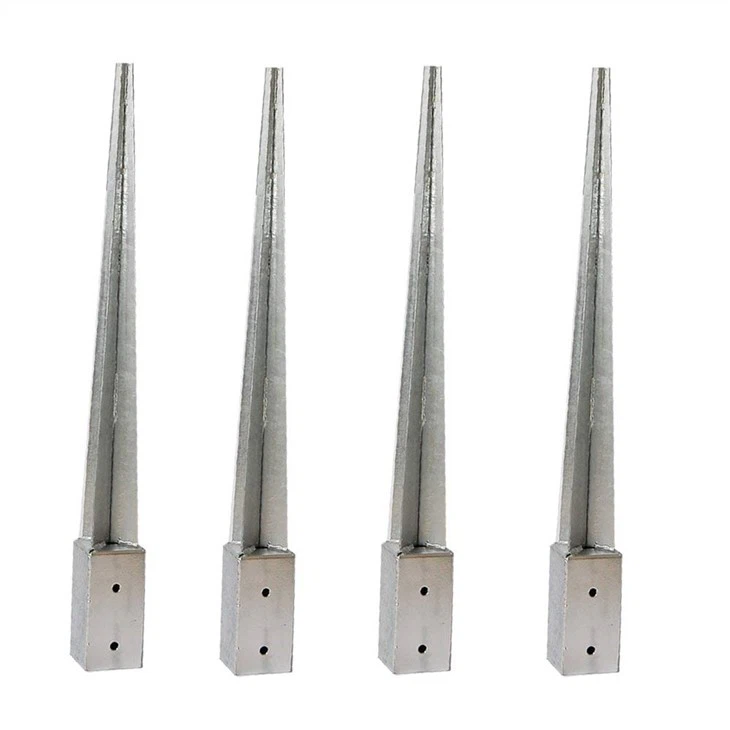
Adding a pointed tip to the round pole anchor, similar to those found in Pointed Pole Anchor, can improve its penetration into the sandy soil. A pointed tip can break through the sand particles more easily during installation, allowing the anchor to reach the desired depth more efficiently.
Grouting
Another option is to use grout around the round pole anchor. Grout is a mixture of cement, water, and sometimes additives. When injected into the soil around the anchor, it can bind the sand particles together, increasing the cohesion of the soil and enhancing the frictional force between the anchor and the soil. However, grouting can be a more expensive and time - consuming process.
Comparison with Other Anchor Types
It is also worth comparing round pole anchors with other types of anchors in sandy soil. Square Pole Anchor has a different shape, which can provide more resistance against rotation compared to a round pole anchor. The corners of a square pole can create additional frictional points with the sand particles, potentially improving its stability.
Pointed pole anchors, as mentioned earlier, are designed for easier penetration. Their pointed tips can help in reaching deeper layers of sand more effectively, which can be beneficial in sandy soil conditions.
Practical Considerations for Installation
When installing round pole anchors in sandy soil, it is important to follow some practical guidelines. First, conduct a soil test to determine the properties of the sand, such as its grain size distribution and density. This information can help in selecting the appropriate diameter and depth of the anchor.
During installation, use a suitable driving method. A hydraulic or pneumatic hammer can provide more consistent force compared to manual driving, ensuring that the anchor is driven to the correct depth. It is also advisable to install multiple anchors in a cluster to distribute the load more evenly.
Conclusion
In conclusion, while round pole anchors can be used in sandy soil, their performance needs to be carefully evaluated. The loose and non - cohesive nature of sandy soil presents challenges in terms of achieving sufficient frictional force and preventing pull - out. However, with proper design, installation techniques, and potentially the use of additional strategies such as increasing the diameter, depth, or using grout, round pole anchors can be made to work effectively in sandy soil.
If you are considering using round pole anchors for your project in sandy soil or have any questions about their performance, feel free to reach out to discuss your specific requirements. We are here to help you make the right choice and ensure the success of your project. Whether you need advice on anchor selection, installation, or load - bearing capacity, our team of experts is ready to assist.

References
- Bowles, J. E. (1996). Foundation analysis and design (5th ed.). McGraw - Hill.
- Das, B. M. (2016). Principles of geotechnical engineering (8th ed.). Cengage Learning.
- Coduto, D. P., Kitch, R. L., & Duncan, J. M. (2011). Foundation design: Principles and practices (3rd ed.). Pearson.


